
Top 10 DevOps Trends For 2024

DevOps is the epitome of collaborative software development and management, where programmers and IT personnel must collaborate and improve communication. This collaborative approach has gained significant traction with numerous organizations, both large and small, fully invested in DevOps.
Harvard Business Review reports that an astounding 80% of companies are on board. Moreover, 86% of businesses worldwide recognize why DevOps is such a huge deal.
Looking ahead, the growth of DevOps is expected to accelerate even further. The worldwideMarketsandMarkets predicts that the global DevOps market will reach an impressive $25.5 billion by 2028. A remarkable annual growth rate of approximately 19.7 percent is forecasted for the period between 2022 and 2028.
As we move into 2024, there are, in fact, some innovative developments imminent that will significantly disrupt the software development and delivery processes of businesses.
This article aims to provide companies with an in-depth analysis of the remarkable DevOps trends and offer insights on how to enhance their development and operations processes.
How has DevOps Evolved over the Past Few Years?
DevOps has come a long way! Here's a quick rundown:
Teams: From fighting to collaborating, Dev & Ops now work together throughout the entire software lifecycle.
Tools: Integrated pipelines deliver software faster and reliably, not just individual tools.
Security: DevSecOps weaves security into development, not just bolted on at the end.
Tech Trends: AI, cloud, containers, and IaC boost efficiency, agility, and scalability.
Adoption: Not just startups anymore, even large enterprises adopt DevOps for agility.
Data-driven: Metrics and data guide decisions for continuous improvement.
Beyond Software: "Everything Ops" expands DevOps to encompass all IT operations.
Top 10 DevOps Trends
The following 10 interesting trends will influence DevOps in 2024.
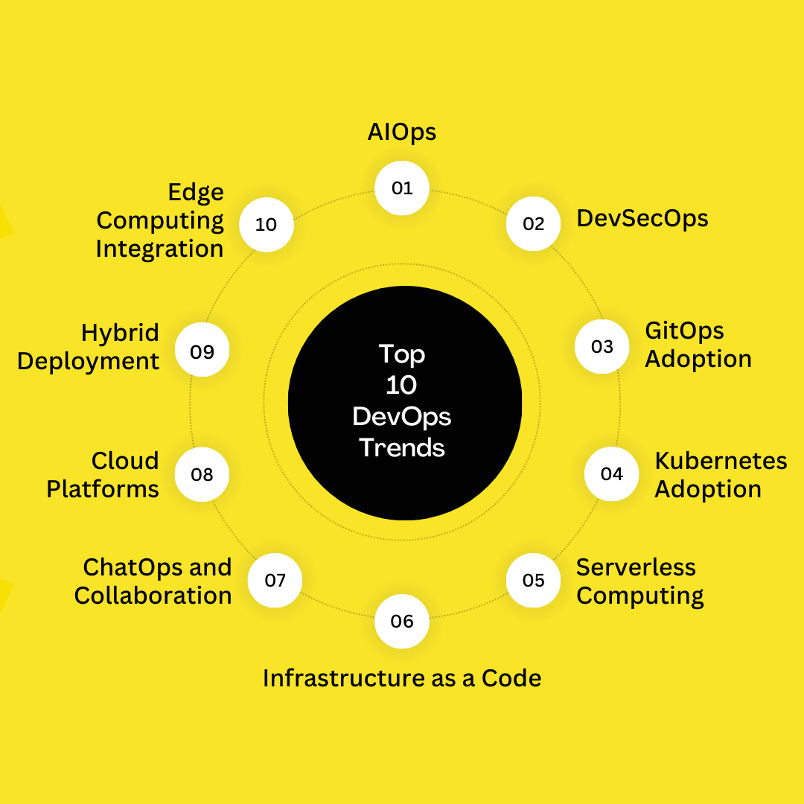
1. AIOps
DevOps is increasingly relying on machine learning and artificial intelligence to automate processes, identify patterns, and foresee problems.
This positive shift allows for more efficient use of resources, quicker problem resolution, and enhanced overall performance. The emphasis is on maximizing existing resources and optimizing operational efficiency.
2. DevSecOps
When it comes to current trends in DevOps,DevSecOps is essential since it unifies cybersecurity, operations, infrastructure, and application development. More secure systems, shorter development cycles, and fewer production difficulties are the results of automating and monitoring security throughout the software development lifecycle.
Integrating security and DevOps is expected to deepen, addressing key improvement areas like security training, authoring security stories, and implementing security use cases.
3. GitOps Adoption
One emerging trend in DevOps is GitOps. It is a methodology for building and deploying software that uses tools like Kubernetes and the Git version management system. Its main goal is to leverage a Git-centric workflow to automate the deployment and administration of infrastructure and applications.
Collaborative development and continuous integration (CI/CD) are some of the greatest DevOps approaches that it integrates. Mettle, a finance firm, partnered with Weaveworks to adopt GITOps to deploy new features quickly and efficiently.
This self-service program allowed engineers to focus on innovation without platform team assistance, increasing production by 50% and deployment by 25%.
4. Kubernetes Adoption
Companies are increasingly developing software natively usingKubernetes, replacing Linux as the benchmark for open-source software development.
This trend is driven by the platform's maturity and ability to support application containers. The industry is expected to coordinate Kubernetes server clusters and multi-cloud solutions this year.
5. Serverless Computing
Serverless computing is a method of developing and running services without directly involving servers. It has significantly benefited the DevOps process, bridging the gap between development and operations and generating pipeline code without needing host development.
Autodesk, a software design company, has streamlined development and deployment by expanding its AWS footprints. Using AWS Dynamodb and AWS Lambda, Autodesk reduced account creation time from two weeks to ten minutes.
6. Infrastructure as Code
One DevOps concept is infrastructure as code (IaC), which means managing and provisioning infrastructure through configuration files rather than manual methods.
Files like this can specify and set up various computer resources like networks, storage, and virtual machines. Organizations may increase the consistency and correctness of their infrastructure settings while decreasing the time it takes to provision and manage it by adopting IaC.
7. ChatOps and Collaboration
ChatOps, a DevOps environment, will transform from communication to a powerful hub in 2024. With advanced AI and natural language processing, chatbots will integrate with CI/CD pipelines, enabling real-time troubleshooting, deployment commands, and proactive issue resolution.
This convergence of human and machine interaction promotes agile and efficient DevOps practices.
8. Cloud Platforms
The importance of DevOps's usage of cloud-based solutions is on the rise. Cloud platforms provide the infrastructure and services to create, test, and deploy applications. Examples of such platforms are AWS, Azure, and Google Cloud.
By offering organizations scalability, flexibility, and a wide range of services, cloud platforms promote the efficient and speedy development and deployment of applications.
9. Hybrid Deployment
To meet specific performance, security, or compliance requirements, hybrid deployment combines on-premises and cloud infrastructure. This strategy is part of DevOps.
By combining the benefits of cloud computing with the need for on-premises infrastructure, organizations can attain greater flexibility through hybrid deployment choices.
10. Edge Computing Integration
By processing data in proximity to the point of generation,edge computing eliminated the reliance on centralized cloud servers.
Applications that demand low latency and real-time processing are supported, and the particular difficulties presented by distributed systems are addressed by incorporating edge computing into DevOps processes.
How much of a need is there for DevOps experts?
The need for DevOps experts is exploding! Companies embracing DevOps practices increasingly require talent to manage the complexity of modern software and automation tasks.
With a skills shortage and rising demand, DevOps careers offer high salaries, competitive market positioning, and a path to future-proof your career in the ever-evolving tech landscape. If you're interested, numerous resources are available to acquire the necessary skills and join this exciting and in-demand field.
Leverage 12 Tech's DevOps Expertise for Transformative Software Solutions in 2024
The amazing trends reshaping the DevOps scene in 2024 are driving the direction of software development in the future. These trends, which range from adopting continuous improvement to harnessing AI's capabilities, present a wealth of chances for businesses to increase security, streamline delivery processes, and, ultimately, satisfy customers.
Revolutionize your DevOps strategy with 12 Tech! Our managed DevOps service ensures seamless integration, automation, and innovation. From Continuous Integration and Delivery for faster deployments to Infrastructure-as-Code (IaC) for efficient management, we've got the scalable solutions and expertise you need.
In addition, you will get a dedicated Ops team guaranteeing uptime, providing 24x7 monitoring and SLA-based responses with an on-call rotation process.
Experience the future of technology with 12 Tech and transform your development productivity with our specialized DevOps services.
Contact us today to start your journey toward digital brilliance!