
In-House vs. Outsourced Development Teams: A Detailed Comparison
With more people working from home, hiring choices have changed a lot. Statista said in a study that IT outsourcing is the biggest IT services market. It's expected to grow to US$777.70 billion in 2028 from US$512.50 billion in 2024. Lower costs are one of the main reasons for this rise.
While outsourcing development is working with a third-party organization that will assemble a team of experts depending on the client's project requirements, in-house development involves employing the talents of the internal team to create software.
To clarify things, we shall examine two models in this article: outsourcing versus in-house software development. It will be simpler to assess the state of your company and select the most suitable development approach for your project once you have a firm understanding of its main features, advantages, and disadvantages. Let's take a closer look!
In-house Development vs. Outsourcing: What’s the Difference?
Adopting an in-house approach grants comprehensive oversight of the development process, guaranteeing adherence to the organization's standards and safeguarding the confidentiality of its intellectual property.
On the contrary, outsourcing is the transfer of particular software development projects or duties to an external provider. Companies that lack the resources and expertise to develop their software extensively use this model.
In addition, outsourcing provides access to a group of developers with the necessary expertise, domain comprehension, and proficiency to execute these responsibilities. This results in financial benefits as organizations only incur expenses for the essential range of tasks performed and do not require a permanent development staff.
Advantages and Disadvantages of In-House Development Team
To figure out which approach will work best for you, you should always look at all of them. The major advantages and disadvantages of developing software in-house are listed below:
Advantages of Having an In-House Development Team
Here are the main Advantages of In-House Development Teams:
Direct Control and Communication
One of the biggest advantages of an in-house team is direct control over development. This improves developer-project manager-stakeholder communication. All parties are open for discussions and clarifications, enabling quick decision-making. An in-house team ensures close alignment since company goals and objectives are strongly ingrained in company culture.
Deep Understanding of the Product and Company Culture
Companies that do well have teams full of energy and live by the company's values. When you do in-house development, you can choose team members who fit your company's culture. You'll get better results when your team works together, which you won't get when outsourcing your work.
Scalability for Long-Term Projects
Scalability is a big benefit of having in-house development teams for projects that will last a long time. As the project changes and more people are needed, the team can naturally grow by adding more coders with the right skills. This natural growth gives everyone on the team a sense of responsibility and continuity, which makes the development process go more smoothly.
Security and Confidentiality
In-house development benefits projects, including intellectual property or sensitive data. Businesses can reduce their risk of data breaches and unwanted access by keeping all development operations inside the corporate firewall. Projects handling secret data or proprietary technology might consider this increased protection necessary.
Disadvantages of Having In-House Development Team
Here are some of the Disadvantages of In-House Development Teams:
Overhead Expenses
Building and maintaining an in-house development team requires significant financial expenditure. Salaries, perks, office space, gear, software licenses, and continual training are all expenses that businesses must consider. This can be a significant burden, particularly for small businesses or those with little resources.
Limited Talent Pool
Another problem with developing in-house software is not having enough skilled IT professionals. Due to this, businesses may have trouble hiring and keeping staff with the appropriate abilities and expertise, which can hurt the quality and productivity of their development projects.
The Turnover Rate Can be High
Your company's best talent is your lesser concern. The real challenge is selecting the right IT consultant for your project. IT specialists are in high demand, and competitors and recruiters will try to steal the finest ones. You may counter-offer your developer more perks, such as raising payroll. Not doing so will cost your team's talent.
Slow Time to Market New Projects
Development of in-house software might be slow. Developers may need to replicate projects and work overtime with a full crew to meet demand. Development projects average one year and 11,415 hours. Modern businesses are competitive; therefore, corporations must distribute their products quickly or risk losing to competitors.
Advantages and Disadvantages of Outsourcing Software Development
Outsourcing is preferred in development because it is less expensive and more scalable than in-house development. However, it has advantages and disadvantages, which we will review below to help you better understand and make an informed decision.
Advantages of Outsourcing Software Development
Here are some of the Advantages of Outsourcing Software Development:
Cost Savings
Companies outsource IT to cut costs, including hiring, training, and hardware and software maintenance.Deloitte's Global Outsourcing Service says cost reductions and human opportunities drive IT outsourcing.
A Large Pool of Talents
Every company seeks economic development and top-tier partners. Outsourcing provides access to global talent and knowledge. Developers with different talents and expertise can meet your needs. This is appealing since each successful project will have an experienced, dedicated crew.
Access to Latest Technologies
Many outsourced development companies stay at the forefront of the latest technologies and technological trends. By partnering with such a provider, companies can benefit from their expertise and leverage their knowledge of cutting-edge tools and methodologies. This can give them a competitive edge in the marketplace.
Tried and Proven Delivery Processes
Most outsourcing organizations have experience in many development projects. Thus, they know product delivery, which benefits outsourcing development businesses. It may assure businesses that the product will arrive on time and within budget, decreasing project failure.
Disadvantages of Outsourcing Software Development
Here are some of the Disadvantages of Outsourcing Software Development:
Communication Challenges
Language limitations and time zone differences can occasionally cause communication problems and impair project responsiveness and coordination, depending on the outsourced provider's location.
Quality Concerns
You can't guarantee quality since you don't control your project's development staff. Your projects will yield various results if you use different developers. Maintaining secure interactions, fostering collaboration, nurturing a positive culture, and ensuring timely delivery are all crucial for scalable success within your firm.
Loss of Management
When you outsource, you give an outside company power over some of your IT tasks. Sometimes, this loss of power makes it hard to stay on track with the company's goals and procedures.
Transparency and Security Risks
Miscommunication can damage trust. Outsourced development projects require trust. It does not always depend on the contractor and developer. Finding the appropriate partner is key. Both sides must acknowledge meeting schedules and report in a way that meets everyone's needs.
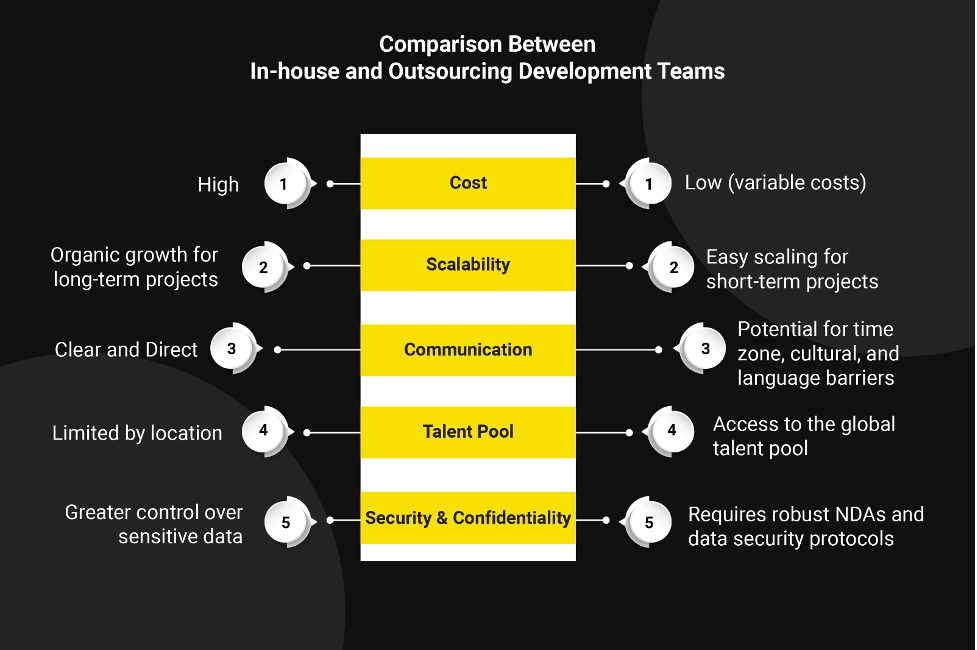
Comparison Between In-house and Outsourcing Development Teams
Choosing the Right Development Model: Factors to Consider
The ideal development model depends on your project. Consider:
Complexity: Complex projects might benefit from in-house control. Simpler ones can be outsourced cost-effectively.
Budget: In-house teams require upfront investment. Outsourcing offers flexibility.
Skills: Need a niche skillset? Look global with outsourcing. Common skills might be well-handled in-house.
Control and Security: Sensitive projects might require in-house development for stricter control.
Project Length: Long-term projects benefit from an in-house team's continuity. Short-term needs can be met with flexible outsourcing.
Improve Your Development Projects with 12 Tech
Building an in-house team provides long-term initiatives with direct control, a thorough understanding of the product, and scalable capabilities. However, it comes with higher prices and fewer talent pools. Outsourced development is cost-effective, provides access to a larger talent pool, and allows for easy scaling for short-term initiatives, but it also raises communication and intellectual property difficulties.
Considering outsourcing for your next development project? 12 Tech can help! Our professional team will analyze your needs and offer the best development approach to ensure your project's success. Contact us now for a free consultation!