
How to Manage Your AWS Cloud’s Security
Cloud technology has been part of the IT world for a few years now. Besides, big enterprises like Amazon and Microsoft are always on a path of innovation - providing more tech-savvy solutions. Platforms like AWS (Amazon Web Services) have made it easier for IT personnel to manage their operations more efficiently.
Yes, it has brought some new challenges, too, but specialists are now free from the stress of the physical installation of hardware or upgradation. They make it all online and modify configuration settings if or when needed. This makes it easy for IT teams to scale their projects and accommodate the overall business growth.
As for the possible challenges, AWS has built-in security features, and they are sometimes hard to understand. However, as one of the popular Infrastructure as a Service (IaaS) platforms, the security features are quite advanced and progressive.
Companies can avoid costly cloud data breaches by implementing proper cloud security solutions for monitoring and responding quickly to incidents.
Cloud computing has many advantages, but unawareness of security measures can keep you awake at night.
In this article, we will talk about the AWS cloud security management strategies and the model it works on. Let’s begin!
How does AWS Cloud Security Work?
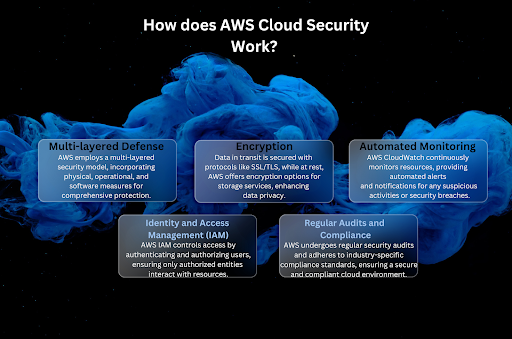
AWS cloud security maintains a shared responsibility model. It ensures adequate protection for the infrastructure that supports AWS Cloud services. AWS manages the security 'of' the cloud, overseeing operations such as patch and configuration management and protecting the cloud architecture against defects. This includes the software, networking, and facilities that enable AWS services worldwide.
This model entrusts AWS customers with security 'in' the cloud. While AWS focuses on infrastructure security, you are still responsible for safeguarding your cloud environment at many levels.
To scale with AWS, you must constantly address and improve your security skills alongside the rest of your management and governance functions. This includes identifying, managing, and resolving security risks and findings throughout all of your environments. As you scale with AWS, you must adjust your AWS security measures to the dynamic nature and temporary lifespan of cloud services.
This adaptation encompasses both reaction mechanisms and ownership. Security ownership may merge with or necessitate the development of new accountability and responsibility models in certain situations.
Although Amazon provides a secure infrastructure with built-in tools and cross-service Transport Layer Security (TLS), AWS still only manages the infrastructure layer and, as with managed services, the service layer.
In the end, the customer is in charge of user authentication and access, operating systems, applications, networks, and third-party integrations.
Security Features that Amazon Provides
Amazon provides various security features and allows customers to secure their workflow and workload.
Encryption:
Amazon encrypts data in Elastic Block Store (EBS), Simple Storage Service (S3), Relational Database Service (RDS), and Redshift. AWS Key Management Service (KMS) offers key control with Server-Side Encryption (SSE) using SSE-S3, SSE-KMS, or SSE-C.
Infrastructure Security:
AWS has the infrastructure security that comes with built-in VPC network firewalls. Additionally, it has dedicated connectivity options with layer 3, 4, or 7 DDoS mitigation. It also provides automated traffic encryption, leaving all AWS facilities secure and sound.
Configuration Management:
In the configuration management module, you can create/close the AWS resources. You can also manage the modifications, manage inventory settings, and use Infrastructure as Code (IaC) templates for secure configurations. Moreover, it also provides a way to create standard virtual machines using Amazon Machine Images (AMIs).
Identity and Access Control:
AWS Identity and Access Management (IAM) is about managing user roles and accounts for the team. By using Multi-Factor Authentication (MFA) and Single Sign On (SSO), you can secure their accounts and company data, too.
Monitoring and Logging:
AWS provides CloudTrail and CloudWatch for monitoring API calls and console actions and also manages standardized logs and GuardDuty. It helps to identify unauthorized activities in real-time.
Multiple Accounts:
Multiple accounts by the AWS Control Tower make it easier for the teams to set up easily and manage operations efficiently.
Best Practices to Maintain Your AWS Cloud Security Strategy
If your company has recently migrated or moved to AWS from existing services, you must incorporate AWS security procedures, too. Yes, its security poses a unique challenge. However, the difficulty is worthwhile because it provides many benefits, such as scalability and flexibility. Some of the features also complicate security and make it more difficult to manage than those created for static on-premises systems.
In short, spend some time and resources to plan effective AWS security strategies that cover all aspects of AWS security. Here are some of the best practices for AWS security:
Outlining an AWS Incident Response Plan
For over a decade, cybersecurity pros have used "Assume Breach" as a battle tactic. However, it is simple to see that any system, person, or account can be used as an attack vector at any time.
With so many attack vectors, one must be prepared for at least one of them.
When you "assume breach," consider where an attacker would likely go to maximize their profits, for example, towards your most crucial data repository.
This highlights the importance of developing a thorough incident and response plan. A strong plan will reduce the collateral harm of a cyber attack. Though the ideal case is to avoid a breach, a comprehensive incident response plan will outline when and where a breach will occur. Also, how to detect it as quickly as possible, the procedures required to mitigate it, and how your company will recover. You can launch forensic workstations and share Amazon Cloud Watch logs for more improved security.
Use IAM Roles for Delegation and Temporary Security Credentials
You need a proper system to manage the processes, and to manage AWS access; you need IAM role management too. These IAM roles are about the temporary permissions to the users and security credentials that are offered to the users of the system.
You can set the expiration date as you want, and it will automatically be rotated when permissions come to an end. These temporary permissions mean you won’t have to worry about revoking them when they are no longer needed. Besides, it is easy to allocate another user on a rotational basis.
Enforcing Compliance Requirements
Usually, businesses create policies for preserving and securing sensitive data. However, the lack of control over the rented cloud infrastructure makes implementing appropriate precautions more difficult. So, while choosing a CSP, businesses should ensure that the provider's data security standards meet their ideals as closely as feasible.
Conduct Risk Assessment for Cloud Assets
As technology is shifting, security teams have to be more alert about the safety of their assets and valuable information. Cyber threat actors are more inclined to target valuable or important assets. They may also inflict more damage on organizations if compromised.
Each asset in the inventory should be assigned an appropriate risk and security level. As a result, security teams should prioritize their efforts according to the risk associated with each of their assets.
Patch Vulnerabilities in Your Applications
AWS empowers businesses to host their own applications and virtual machines in the cloud. The lack of tangible devices, such as servers or network equipment, might create a false impression of security. However, assets in the cloud may still include vulnerabilities that attackers might exploit.
Organizations should have a vulnerability management policy in place that outlines how to deal with cloud-based vulnerabilities. Security teams should act quickly to detect and patch vulnerabilities before adversaries may exploit them.
Back up Your Data
When a malicious actor accesses a system, their aim could range from deleting or stealing data to crashing the system.
AWS Backup is the simplest method for keeping your data secure and recoverable. It also supports a wide range of different services, including S3 buckets, EBS volumes, DynamoDB tables, and more.
You can easily automate backups from the console, set backup policies and requirements, and then apply those policies to other AWS services using the tagging system.
Bottom Line
As you establish the AWS cloud security management, always keep the above-mentioned cloud security best practices in mind.
Other than that, you can always have support from a professional AWS security consultant and get third-party solutions for advanced security features. For your custom cloud services and solutions, 12 Tech is always here to help you make your path secure.