
Effective Backup and Recovery Strategies on AWS
Many businesses consider managed cloud services (e.g., AWS Services) the best option for streamlined business, but they also face some online security challenges. Cyber threats and attacks can cause data loss and financial problems. Therefore, it is always better to have comprehensive backup and data recovery strategies in place.
When your company migrates to AWS, you need a data protection plan. This plan keeps the data safe and ensures proper recovery during unexpected security breaks. With the right data backup and recovery plan, you can both prevent and reduce the impact of the disaster.
If your company doesn’t have AWS backup and recovery strategies, the information in this article can help you get started.
Understanding the Challenges of AWS Data Backup and Recovery
When planning the strategy for backup and recovery on AWS, it is important to be aware of potential problems. Additionally, it is crucial to plan with a clear understanding of the impact these issues can have on your business.
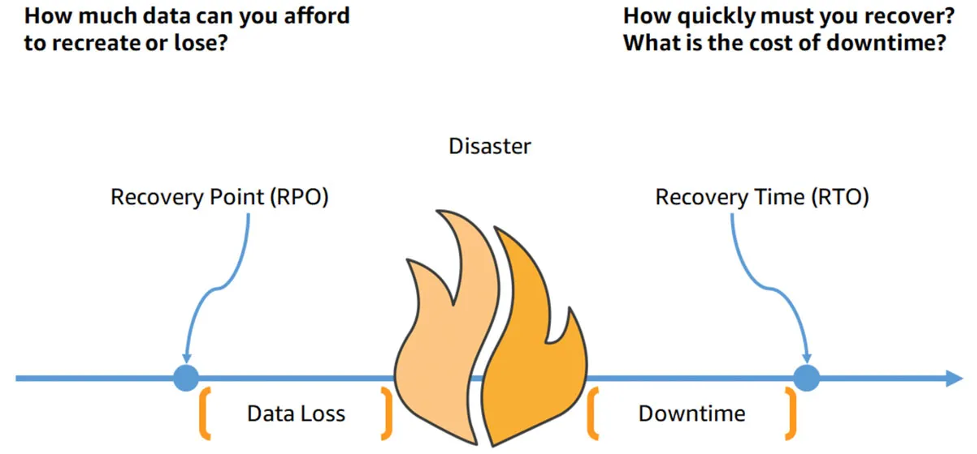
Remember that your goal here is to have a recovery strategy to back up the data and avoid downtime. You will adhere to the approved recovery goals -Recovery Time Objective (RTO) and Recovery Point Objective (RPO).
RTO refers to the allowable time between service disruption and restoration.
RPO refers to the allowable period since the last data recovery point.
Consider a detailed backup strategy that includes Point-in-Time Recovery (PITR), Continuous backup cadence, File-level recovery, Instance-level recovery, application–level recovery, and Volume-level recovery.
Effective Backup and Restore Strategies in the Cloud
With all the data efficiency needs, more and more businesses are managing their workloads through cloud services. Yes, it has many benefits, but this transition also demands that AWS backup and recovery strategies be in place.
Always know the best cloud data backup practices to benefit from cloud services without stressing over data breaches.

Automate Backup Policies
As your AWS configuration grows, managing and maintaining it effectively becomes challenging. Dealing with data protection on a larger scale, where numerous AWS accounts have identical requirements, necessitates a thorough backup strategy.
As a result, enterprises should consider using either native AWS backup solutions (for example AWS Backup) or third-party products. Cloud Solution Architects, IT administrators, and DevOps teams can easily create backup plans using these technologies. This simplifies day-to-day management and allows them to devote more time to essential team duties.
Utilize Cost-Effective Storage Solutions
The more backups you save, the more storage costs you incur. As time passes, this adds up and results in increased costs, particularly when dealing with big amounts of data or storing data for extended periods. It's critical to strike a balance between lowering costs and the retention period and accessibility of your data.
To address this, AWS backup solutions integrate with several AWS storage services, such as Amazon S3 and Amazon EBS.
Use Lifecycle Policies
In addition you should have an effective archival policy in place that moves older less frequently or rarely accessed data from expensive hot storage tiers to cheaper cold ones. Within AWS you are going to implement S3 life-cyle policy to transition the data to various tiers (for example from S3 standard to Glacier)
Leveraging Amazon's lifecycle policies can help enterprises automate backup lifecycle processes and manage storage costs more effectively. You should have an effective dta archival policy in place that moves older less frequently or rarely accessed data from expensive hot storage tiers to cheaper cold ones. Within AWS you are going to implement S3 life-cyle policies to transition the data to various tiers (for example from S3 standard to Glacier) and eventually delete it
With the lifecycle policies, you can also align your backup and recovery strategies with business needs. Moreover, It eliminates the need for manual intervention and contributes to AWS cost optimization. Also, this strategy keeps superfluous backups from taking up storage space, supporting a more structured storage system and lowering total expenses.
Implement Disaster Recovery Plans
After all, having backup data serves little purpose if there is no viable means of accessing it during urgent situations. Ultimately, even the most robust disaster recovery plans may encounter challenges when confronted with the unexpected issues of the real world.
Therefore, maintaining recent backups of your company's data in disaster recovery is crucial.
With features like S3 versioning and cross-region replication, you can ensure additional safety by storing your data in multiple locations, even in the event of an outage in one data center or entire region. Moreover, with AWS, you can automatically create copies and take snapshots. This implies that you can resume operations without delay in a disaster.
Regularly Test Your Disaster Recovery(DR) Plan
Once you've decided on a data recovery technique on AWS and have everything operational, evaluating its effectiveness through testing is critical. Fortunately, cloud platforms' ability to mimic production environments makes testing your disaster recovery plan against several situations easier than ever.
The more thoroughly and frequently you test your disaster recovery plan, the more equipped you will be for an actual crisis. Remember that proactive prevention is far more useful than coping with the repercussions.
Regularly conduct tests on your disaster recovery plan to ensure it is operational and up to date. AWS provides various testing tools, like AWS CloudFormation and AWS CloudTrail, to assist you in validating your plan.
By testing your disaster recovery strategy regularly, the continuous operation of your application or service, even in the face of a crisis.
Use Established DR strategies
Adopting established Disaster Recovery (DR) strategies such as Backup and Restore, Pilot Light, and Warm Standby is essential for organizations aiming to safeguard their operations against data loss and downtime. These methodologies offer proven frameworks for preparing and responding to unforeseen events, ranging from technical failures to natural disasters.
Backup and Restore: provide a fundamental safety net by keeping copies of critical data, which can be restored to reinstate operations.
The Pilot Light approach keeps a minimal version of an environment running in the cloud, enabling rapid scaling up in an emergency.
Warm Standby involves maintaining a scaled-down but fully functional version of the system that can be quickly brought to full capacity.
The Active/Active strategy is particularly effective for achieving high availability by running applications in multiple locations simultaneously, allowing for seamless failover and load balancing
By incorporating these established DR strategies, organizations can ensure they have a resilient infrastructure in place, minimizing recovery times and ensuring continuity of operations with minimal impact on their business.
Alerts, Notifications, and Integrations
When a crucial backup job goes wrong, having the right information at the right time can be the difference between success and failure. If the right people get notified, whether customers, team members, or managers, you can find and remediate the problem quickly.
Immediate notifications of failed backup jobs through emails, sms, ticketing systems or other integrations lets identify and fix issues in backup jobs and avoid data loss disasters.

Bottom Line
Using AWS backup and recovery solutions can benefit you when looking for a more extensive approach to managing your backup and recovery plans. These solutions provide a comprehensive approach to protecting your EC2 instance data, frequently including additional features such as enhanced backup frequency, greater compression, and tighter security configurations.
If you are looking for comprehensive implementation of AWS backup and recovery strategies, our experts at 12 Tech are happy to help.