
DevOps Team: In-house or Outsourced?
Software creation has gone through a big change recently. The introduction of DevOps has dismantled the conventional barrier separating operations and development. This method emphasizes communication, automation, and continual improvement to optimize the software delivery pipeline.
DevOps has garnered significant importance due to its ability to streamline deployments, enhance software quality, and improve customer responsiveness.
Organizations must prioritize enhancing their development procedures and gaining a competitive advantage to construct a formidable DevOps team, in-house or outsourced. By conducting a comparative analysis of the advantages and disadvantages of both approaches, this article aims to aid in the identification of the one that most effectively meets the requirements of your organization.
In-House DevOps Vs Outsourcing: A Statistical Overview
The following are some essential statistics to contemplate:
- The market share of IT outsourcing is anticipated to attain $98 billion by 2024.
- When compared to internal operations, outsourcing can minimize expenses.
- 72% of the values of global outsourcing contracts are allocated to IT services.
These numbers illustrate the increasing tendency of organizations to utilize outsourcing to improve productivity and create value. Nevertheless, meticulous evaluation of a multitude of factors is imperative before concluding.
In-House DevOps Team: Benefits and Drawbacks
An in-house DevOps team is a group of IT professionals within an organization that combines the expertise of software development (Dev) and IT operations (Ops).
They bridge the gap between developers and IT operations, aiming for faster, higher-quality software releases. Forming an in-house team demands extensive collaboration to achieve high-quality work and avoid errors.
Benefits of Having an In-house Team
Implementing an in-house DevOps team can yield many benefits for the organization. Notable among the key advantages of this setup are the following:
Control and Oversight: An internal team provides one with full authority and supervision over the implementation and strategy of DevOps. The user exercises direct supervision over their work, enabling them to make modifications and establish priorities based on their particular requirements.
Deep Understanding of Company Culture and Process: An internal DevOps team integrates seamlessly into your company. They attained an extensive comprehension of your organization's culture, procedures, and challenges. This facilitates improved dialogue and enables them to customize their resolutions to suit your context.
Enhanced Collaboration with Other Internal Teams: An increased level of collaboration is facilitated with other internal teams, such as IT, security, and development when a dedicated DevOps team is present. Efficient information sharing and de-silos facilitate accelerated problem-solving and innovation using this streamlined communication.
Drawbacks of Having an In-house Team
Although there are advantages to employing an in-house approach, it is not devoid of consequence. You should be aware of the following significant drawbacks:
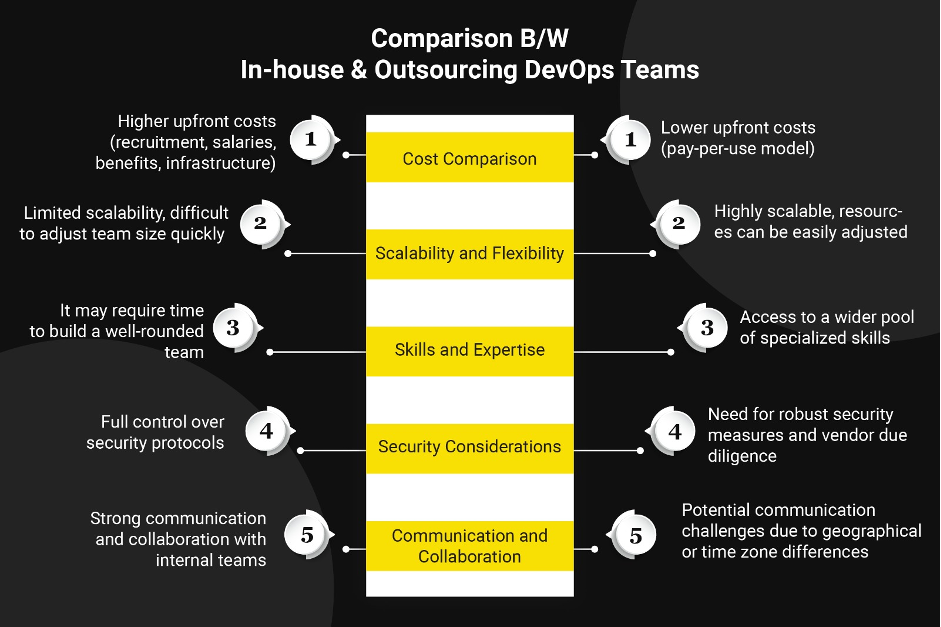
Significant Investments in Recruitment and Training: Constructing a robust internal DevOps team necessitates substantial financial outlay. Continual training is critical to ensure competent professionals remain current with the most recent tools and technologies, as their recruitment can be costly.
Limited Scalability: The capacity of an internal team is frequently fixed. Adapting the scale of a project to fluctuating demands can present difficulties. You might encounter challenges in meeting deadlines during periods of high demand or underutilizing resources during periods of low activity.
Retention Challenges: Like any other team, in-house DevOps specialists can be vulnerable to attractive offers from outside companies, leading to knowledge drain and project disruptions. Replacing them is expensive and time-consuming, requiring investment in recruiting, training, and onboarding new hires.
Outsourced DevOps Team: Benefits and Drawbacks
DevOps outsourcing is having a third-party provider develop, create, and integrate DevOps solutions for your firm. They establish a competent team, handle day-to-day operations, and incorporate other DevOps principles like automation, continuous monitoring, and validation. If properly implemented, it provides firms with trained resources and experience while avoiding the cost and hassle of forming in-house teams.
Benefits of Having an Outsourced Team
Companies can experience transformative advantages by outsourcing the DevOps team. The following are several pivotal benefits:
Cost-effective Solution: In contrast to building a team internally, outsourcing DevOps could be a viable and more economical alternative. You circumvent the expenses related to personnel, wages, perks, and physical workspace. A further benefit is that you only pay for your required services, making it an economical choice.
The accessibility of specialized skills and knowledge: It is common for outsourcing providers to have a vast pool of exceptionally skilled DevOps specialists with various areas of expertise. One can acquire access to expertise and capabilities that are difficult or expensive to procure internally by leveraging the experience of others.
Scalability and Flexibility: One of the primary benefits of outsourcing DevOps resources is their ability to be easily adjusted per changing project requirements, incorporating scalability and flexibility. By leveraging this adaptability, one can ensure their team has the necessary skills to manage workloads and minimize expenses effectively.
Drawbacks of Having an Outsourced Team
Outsourcing has possible drawbacks, regardless of its numerous advantages. A few of the primary disadvantages are as follows:
Difficulties in Communication: Disparities in geography and time zones may impede communication with an outsourced team. To surmount these obstacles, it is critical to implement collaboration tools and clear communication protocols.
Insufficient Comprehend of Organizational Culture: Outsourced teams might have a diminished familiarity with the intricacies of your company's culture and unique business requirements. Inefficiencies and miscommunication may result as a consequence.
Possible Security Issues: Outsourcing DevOps requires faith in a third-party vendor's code and infrastructure. These dangers can be reduced by implementing strong security measures and completing extensive partner due diligence.
Comparison Between In-house and Outsourcing DevOps Teams
Determining the Merits of Outsourcing Versus In-house
Several critical factors must be considered when deciding between in-house and outsourced DevOps. A summary of the criteria for assessing each one is as follows:
The level of technical intricacy: Projects that are exceedingly complex and have distinct requirements may derive greater advantages from an in-house team's comprehensive knowledge of your environment. On the other hand, inexperienced external teams could effectively oversee less complex undertakings.
Availability of Specialized Expertise In-House: Outsourcing can offer prompt access to specialized expertise if an organization lacks the requisite DevOps capabilities. Although developing a permanent workforce presents numerous advantages, establishing an internal team may require a substantial financial outlay for hiring and training.
Obtaining Access to Cutting-Edge Technologies via Outsourcing: Outsourcing partners frequently maintain a leading position in technological progress.External resources may be available to the organization, including access to state-of-the-art instruments and specialized knowledge.
Infrastructure Management Needs: Consider the current state of your IT resources and installed infrastructure. DevOps infrastructure management may be feasible if an organization possesses a strong internal IT team. Otherwise, infrastructure administration can be incorporated into a turnkey solution via outsourcing.
Ensuring Security Prioritization: If your projects entail handling exceedingly sensitive data or stringent security protocols, utilizing an in-house team may provide you with enhanced control and supervision. Yet, certain outsourcing partners possess expertise in implementing secure DevOps methodologies and can offer robust security assurances.
Ensuring Regulatory Compliance: Regulatory compliance requirements can be rigorous in certain sectors. Succeed confidently by assessing how much your outsourcing partner has complied with pertinent regulations.
Prioritize Testing Protocols and Quality Assurance: Both internal and external teams can produce superior quality results. Notwithstanding the selected model, it is crucial to establish unambiguous expectations regarding testing and quality assurance procedures to guarantee their unity with one's standards.
12 Tech Can Enhance Your DevOps Projects: Explore Now!
The optimal strategy is the one that empowers your organization to deliver software of superior quality at an accelerated rate. Regardless of whether you opt for an in-house or outsourced model, remember that achievement is contingent upon effective communication, cooperative efforts, and a dedication to ongoing enhancement.
Ready to investigate how outsourcing can enhance your DevOps strategy?12 Tech is an industry-leading provider of DevOps services backed by a solid reputation for accomplishments and abundant knowledge. Contact us for more information on how we can assist you in reaching your DevOps objectives.